




“Someones project just went commercial”
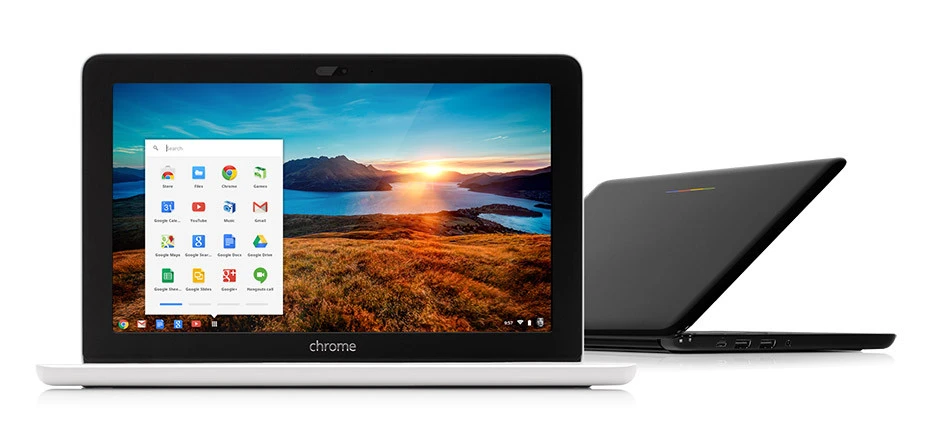
So, I got this line on Skype from a close friend today. He had read an article on Techcrunch and promptly shared the link with me – “Google Reveals HP Chromebook 11, A $279 Chrome OS Notebook That Charges ” . And after a few seconds, it hit me! An idea that I and two clever young ladies thought up as our bachelors degree final year project 5 years ago had been implemented and released today by Google as a 2013 innovation!
To be VERY clear, this article is not aimed at insinuating that Google used our idea or that we deserve some rights to the Chrome sales (would be nice if we got some kickbacks though  ) . It is just gratifying and a “major validation” (as my friend put it) of our thought process back then to see that the Big G is implementing use cases we had discussed 5 years ago.
What Exactly Did We do 5 years Ago ?
Rewind back to 2007, it was a hot and sunny afternoon , in a classroom at a University in Western Nigeria. We had just become team mates (I and two smart young ladies) in the first semester of our final year and had been instructed by our supervisor to brainstorm on 2 clever ideas for topics we would like to work on. One of the ideas we thought up was a curious device that would enable a laptop get charged using USB power. We christened this device the “Network Power Sharing Device NPSD”. Hehe. Back then, many said the idea was creepy/silly but we built it anyway.
To better understand our line of thought, it would be needful to explain that in Nigeria, electric power supply was more of a luxury than a constant service. On the average the power was out more that it was on. Thus, being able to charge a laptop from a Car USB, or briefly from another laptop’s USB port was not just practical but also profound.
Camera’s and mp3’s could charge off of USB ports and we found it rather disappointing that there weren’t any special power converters that could make it possible to charge whole laptops using USB power only. So we set out to create just that! A circuit that would accept USB power (500mA/ +5V), condition it (step it up … blah blah) and feed out the required output power ( 18V-19V/4.5A) to charge a laptop! On one end it would have a USB cable as the source and on the other end a laptop power input cable. I already hear the engineering guys screaming foul and impossible! Hehe . Try we did . We were students of computer engineering technology but with very scant experience dealing with electrical/electronic circuit design and this was our first limitation. After reading up and designing the original circuit, we discovered even more limitations. There were a couple of chips (I cant remember the exact ones at the moment) which we needed to implement our circuit but just couldn’t find in the entire Nigeria. Internet access was a luxury and ordering stuff online was still a big deal back in 2007 . Even if we did order it, it was likely to get lost in transit. So we designed our own “less efficient” version of the chips we couldn’t purchase. We tinkered around for several months, and decided to throw in some complexity while we were at it. We had an extra USB cable connected to the destination laptop (being charged) with a custom java software (driver) running on it. The software would monitor the battery level of the destination laptop and initiate the charging process. Sweet!
What did we achieve ?
First, I’d like to mention we had an A grade. Super!
We also learned that stepping up 5V and 0.5A to 18v 4.5A wasnt as easy as we thought it would be . But we achieved enough power to make the NPSD device “charge” a hp laptop when in sleep mode. Back then, LCDs were power hungry, as well as processors, ensuring we couldn’t charge when all these were on. Today’s displays and processors consume much less power and a slew of low power chips have made it possible for Google to release a USB chargeable laptop. And yes, we did try to document our findings back then and published a paper about our ideas at an international conference held in Varna, Bulgaria . Not a bad paper for struggling 19 and 20 year olds excited about their first project.
Here’s the abstract to the paper.
The ongoing migration of mobile lifestyles and the increasing capabilities of portable systems will continue to drive demand for more flexible and portable battery charging systems (Brown, 2006). The use of computers has been limited due to lack of constant availability of power – issues such as data loss, transaction breakages, data compromise have become major challenges in areas (especially third world countries) where power supply is a problem. Thus there is a need to provide a means of power sharing through USB for computers to share power between two systems (with special emphasis on laptops). Related works/ research has shown that the power sharing between a computer system has only been possible with smaller devices like iPod, since the USB port gives 500mA/ +5V maximum. This paper describes a device that draws similar voltage and current as the iPod for a destination system after an amplification operation has been carried out on the supplied voltage and power. The power being transferred is initiated by the software driver on detection with destination voltage and current 18V-19V/4.5A with female connector. After construction it will be available to notebook computers system specification and very useful in emergencies and available to all due to its ease of use.
Ambitious ! I remember we hoped to develop some commercial prototype and even sell them. That didn’t happen. You can peruse/download the full paper here.
While the Chromebook’s implementation definitely differs from ours (in that the entire circuit is built into the laptop), it follows the same use case ( general ease of use, and in emergency situations). Thanks for the validation Google. In hindsight, I imagine that we would have achieved much better results if we did have access to the required training, and hardware . One to the next idea … hopefully , the paper above gets some good citations.

![Gidigames Android Board Game is Going Open Source [Happy New Year!]](/blog/wp-content/uploads/2015/01/Screenshot_2015-01-01-13-23-07-150x150.webp)